Methane Accounting Today

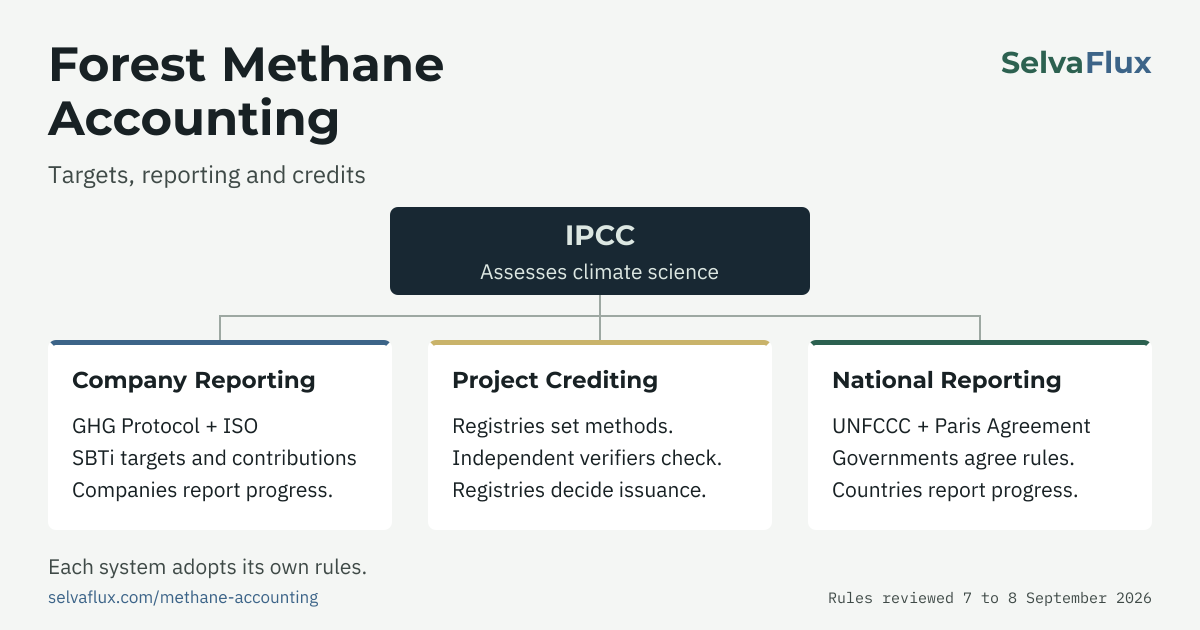
Different institutions set the rules for company reports, climate targets and project credits. Their decisions determine how bark methane uptake could be used.

Rules reviewed . Contribution rules checked .

How the Organizations Fit Together

Follow the scientific input to each system. Select a body for its full name, role, founding organizations and sources.

The molecule marks areas where bark methane uptake may have a role. Select it to read more.

publishes
Assessment reports, inventory methods and climate metrics

These findings inform each system.

Company Accounting

set reporting rules

Company Inventories

Companies report their emissions and eligible removals.

GHG Protocol accounting informs
sets requirements for

Targets and Contributions

Companies act and report progress. SBTi Services validates targets.

Project Crediting

require independent checks by
the program then decides issuance

Credits in a Registry

The registry records issued units. Voluntary buyers and compliance programs have their own acceptance rules.

National Rules

governments adopted
countries implement it through

National Plans and Reports

Countries report emissions and removals, track commitments and account for international transfers.

Each body decides which science its rules adopt. Article 6 of Paris can connect project crediting with international cooperation. [7][3][34][13][15]

IPCC

Intergovernmental Panel on Climate Change

The United Nations (UN) body that assesses climate science. Its assessment reports provide the scientific basis for methane metrics. Its inventory task force develops methods for national greenhouse gas inventories.

The World Meteorological Organization (WMO) and United Nations Environment Programme (UNEP) established the IPCC in 1988. It has its own intergovernmental structure and operates independently of the UNFCCC. It assesses published research. Governments and standards bodies decide how to use its findings in their rules. [1][2][7]

How IPCC assessments affect methane accounting

GHG Protocol and ISO

Greenhouse Gas Protocol

A standards initiative that sets rules for preparing emissions and removals inventories. Companies use its Corporate Standard to report their greenhouse gas emissions.

The World Resources Institute (WRI), a research organization, and the World Business Council for Sustainable Development (WBCSD), a business membership organization, convene GHG Protocol. GHG Protocol has a steering committee, an Independent Standards Board and technical working groups. Corporate inventories distinguish direct emissions (Scope 1), emissions from purchased energy (Scope 2), and other value-chain emissions (Scope 3). SBTi sets separate requirements for target progress. [3][17]

International Organization for Standardization

An independent, nongovernmental standards organization made up of national standards bodies. Its greenhouse gas standards address organizational accounts, project quantification and verification.

ISO 14064-1 addresses organizational inventories, ISO 14064-2 addresses projects, and ISO 14064-3 addresses validation and verification. ISO and GHG Protocol are developing a joint corporate accounting standard. Conformity with an ISO standard alone does not authorize credit issuance or target use. [11][12][20]

Current company reporting rules

SBTi

Science Based Targets initiative

An independent charity that develops company climate-target and contribution standards. Companies prepare GHG Protocol inventories for target-setting. Its wholly owned subsidiary, SBTi Services, validates company targets. Its Forest, Land and Agriculture guidance is known as FLAG. Its Ongoing Emissions Responsibility (OER) framework addresses company climate contributions.

SBTi grew from collaboration involving CDP (formerly the Carbon Disclosure Project), the World Resources Institute (WRI), World Wide Fund for Nature (WWF), United Nations Global Compact and We Mean Business Coalition. Its current Board of Trustees governs the charity, with a Technical Council supporting standards work. [4][5][34]

Methane contributions and FLAG targets

Registries

Verra, Gold Standard and Isometric

Verra is a nonprofit organization; Gold Standard is a foundation; Isometric is a company. They set crediting requirements and administer issuance. Their registries record projects and units, including issuance and retirement.

WWF and other international nongovernmental organizations established Gold Standard in 2003. Verra was founded by environmental and business leaders in 2007 and is governed by its Board of Directors. Verra operates the Verified Carbon Standard (VCS). A VCS methodology supplies activity-specific eligibility and calculation rules; independent validation and verification bodies assess project design and reported results. Verra then reviews the request for issuance, and the Verra Registry records issued Verified Carbon Units. Program approval and independent verification are separate responsibilities. [31][32][33][13]

Current bark methane crediting proposals

Independent Verifiers

Validation and Verification Bodies

Independent organizations assess a project's design and reported results against a crediting program's requirements. Validation assesses the design; verification checks the reported outcomes.

Programs such as Verra's Verified Carbon Standard (VCS) set eligibility requirements for these bodies. An assessment can support a request for credits. The program makes the issuance decision, and its registry records the units. ISO 14064-3 provides requirements for greenhouse gas validation and verification. [13][12]

What bark methane crediting would require

UNFCCC

United Nations Framework Convention on Climate Change

The UNFCCC is the international climate convention. The Paris Agreement is a treaty adopted under it. Participating governments decide the rules for national reporting and international cooperation.

The UNFCCC secretariat, known as UN Climate Change, supports implementation and negotiations. COP means Conference of the Parties to the Convention. CMA means the Conference of the Parties serving as the meeting of the Parties to the Paris Agreement. A CMA decision can specify how countries use IPCC science in Paris reporting. [6][14][7]

National reporting rules for methane

Paris Agreement

Paris Agreement

A legally binding climate treaty adopted under the United Nations Framework Convention on Climate Change (UNFCCC). Countries set nationally determined contributions (NDCs), their climate plans, and report on implementation.

Participating governments decide implementation rules through the CMA, the meeting of Parties to the Paris Agreement. Article 6 covers voluntary cooperation, including international transfers, a UN crediting mechanism and non-market approaches. Each use has its own requirements. The article list below focuses on possible uses for nature-based methane. [14][15][28]

Where nature-based methane could fit in Paris

Shared Founding Organizations

CDP, WRI, WBCSD, WWF, UN Global Compact and We Mean Business Coalition

The World Resources Institute (WRI), a research organization, helped establish GHG Protocol and SBTi. World Wide Fund for Nature (WWF), a conservation organization, helped establish SBTi and Gold Standard. Each institution has its own governance.

CDP, formerly the Carbon Disclosure Project, runs an environmental disclosure system. It and the World Business Council for Sustainable Development (WBCSD), a business membership organization, are founding members of We Mean Business Coalition. The coalition coordinates business climate action. UN Global Compact is a special initiative of the UN Secretary-General for responsible business and was a founding partner of SBTi. [8][9][10][4][3][32]

All acronyms and full names

Where Bark Methane Fits

Consider a forest project: a company first funds a pilot, then considers how to use its results. Funding, reporting and target use raise different questions.

Funding the Pilot

SBTi’s Ongoing Emissions Responsibility (OER) framework provides for company contributions alongside required emissions reductions.

Its research and advance-funding categories could support methane pilots that meet its eligibility and integrity requirements. The standard takes effect on 1 February 2027. [34]

1tonne of methane

Using a Demonstrated Result

Suppose the project demonstrates 1 tonne of methane uptake over a year above what would have happened without the project. Reporting can express it in carbon dioxide equivalent (CO₂e), using a specified climate metric.

Company Reporting

Under GHG Protocol, the company would need to show how the forest relates to its operations or supply chain, and use an applicable method. From 1 January 2027, the Land Sector and Removals Standard provides for separate reporting of non-CO₂ removals. It does not supply a bark methane method. Purchased credits remain separate from company emission totals. [18][17]

Company inventories, forest coverage and ISO revision

GHG Protocol: Corporate Standard; Land Sector and Removals v1.1

Land-sector rules take effect 1 January 2027

GHG Protocol company inventories report each gas by mass and in CO₂e. Purchased credits are reported separately from scope totals.

Land Sector and Removals Requirement 19 provides for separate reporting of non-CO₂ removals. A method for accounting for bark methane uptake is still needed.

Next: Land-sector rules take effect in January 2027. A joint corporate revision with ISO has consultation scheduled for Q2 2027 and publication for Q4 2028.

Land Sector and Removals v1.1 was published in June 2026. Requirement 19 places reported non-CO₂ removals separately from Scope 1 and Scope 3 removals in the physical inventory. The standard covers specified agricultural tree systems and forest-related emissions, but does not provide a complete forest carbon framework. Forest carbon evidence is due 1 February 2027; a review of the standard is due by 2030.

The joint corporate revision with ISO includes work on Actions and Market Instruments. This work is exploring separate statements for physical inventories, contractual accounting and action impacts. Interim advice is to keep those statements separate, without netting them together. Target and disclosure programs still decide which statements they accept.

[17][18][19][20]

SBTi Contributions and Targets

OER contributions. Biological methane uptake may fit the natural-sink category; its classification needs confirmation. Quantified contributions require CO₂e values and independent assurance. [34]

FLAG targets. Forest, Land and Agriculture (FLAG) rules accept eligible CO₂ removals. Bark methane does not qualify under that rule. OER outcomes cannot also meet the company’s SBTi emissions targets or be deducted from its reported emissions. [21][34]

FLAG rules and the OER criteria

SBTi FLAG: Forest, Land and Agriculture guidance v1.2

Current guidance; v2 in development

Eligible removals under FLAG are CO₂ removals within the company's land or value chain. The metric guidance specifies AR6 GWP100.

Bark methane removal does not qualify under the current CO₂ removal rule.

Next: Evidence survey closes 8 October 2026. SBTi has not set a final FLAG v2 publication date on the page reviewed.

Section 3.1.4 requires ongoing CO₂ storage and monitoring. Purchased offsets cannot meet near-term FLAG or energy and industry targets. The FLAG metric guidance excludes GWP*.

[21][22][23]

SBTi Corporate Net-Zero: Standard v2

Published; submission transition ahead

Version 2 was published on 11 June 2026. Submissions during 2026 use v1.3.1.

Ongoing Emissions Responsibility provides a separate route for recognition of contributions. Methane project eligibility must still be established.

Next: The standard lists 1 February 2027 as its effective date. Both versions are available through 31 January 2028 during the submission transition.

After 31 January 2028, new submissions must use v2.

[24][34]

OER Classification and Assurance

C41.3 covers contribution-budget funding for research, advance mitigation and enabling work. C41.1 includes enhancing natural carbon sinks, without expressly classifying atmospheric methane oxidation.

C42 requires safeguards, documented impacts and assurance. Quantified outcomes also need additionality, conservative measurement and unique allocation. C43.1 excludes OER outcomes from Scope 1 to 3 target implementation and inventory netting. C43.3 permits some separately reported inventory removals to contribute to OER if they are not also used toward other SBTi targets. [34]

Project Credits

The project would need an approved method and verification under its chosen program. Verra’s bark module is on hold. Gold Standard is considering a concept. No bark method was identified for Isometric in this review. [25][26][27]

Verra, Gold Standard and Isometric records

Verra: Bark methane module M0423

On hold since 1 April 2026

The proposed module would quantify methane removal through bark and complement forest project methodologies. It is not approved.

Resuming development would still leave methodology approval and project issuance to be completed.

Next: Verra will reassess whether to resume development in Q1 2027.

Verra names SelvaFlux as the submitter. Existing methane methods cover other activities: VMR0016 quantifies landfill-gas emission reductions.

[25][29]

Gold Standard: Bark methane concept NMC 187

Concept consideration

Gold Standard lists SelvaFlux's proposed bark methane module for afforestation and reforestation projects at concept consideration.

The concept remains under consideration. There is no approved bark methane crediting route in this record.

Next: The record lists methodology development as the next step. It gives no date for that step or for approval.

The public record names the proposal 'Quantification of CH₄ Removal via Bark Methanotrophy: Module for A/R Projects'. Its start date is 26 August 2025.

[26]

Isometric: Standard v2.1

Published standard

The standard uses CO₂e units and defaults to AR6 GWP100 unless a protocol or module specifies otherwise.

Bark methane crediting would need an applicable protocol.

Next: No bark methane protocol or approval date is established by the standard reviewed.

The standard's scope covers atmospheric CO₂ removal and specified emission reductions from existing emitters.

[27]

National Reporting

The host country would need a suitable estimation method and reporting treatment under UNFCCC rules. Nationally determined contributions (NDCs), countries’ climate plans, could account for bark methane uptake. [28][14]

National inventory rules and international transfers

UNFCCC / Paris: Decision 18/CMA.1

Current transparency rules

National reporting uses AR5 GWP100, or values from a later IPCC assessment agreed by the CMA. Countries also report each gas by mass.

A country would need a method for estimating bark methane uptake and reporting it in its UNFCCC inventory. Article 6 transfers would also need the applicable authorization and accounting rules.

Next: A later IPCC assessment changes the required metric only when the CMA adopts it. No bark methane adoption date is established here.

Paragraph 37 permits supplementary reporting using other metrics; paragraph 47 addresses gas-specific reporting. National inventory reporting does not create a tradable unit.

[28][15]

What Needs Clarification or Change

A useful next step may be clarification under published rules, as with OER classification. Other uses depend on new methods or revised standards. Each decision belongs to the body responsible for that use.

How IPCC Assessments Enter the Rules

AR5 and AR6 are the IPCC’s Fifth and Sixth Assessment Reports. They supply values for metrics such as 100-year global warming potential (GWP100).

GHG Protocol recommends AR6 values; SBTi FLAG specifies AR6 GWP100. Paris reporting requires AR5 GWP100, or later values adopted by its governing body. A new IPCC report does not automatically change these rules. [16][22][28]

Conversion example and reporting versions

Isometric Standard v2.1 defaults to AR6 GWP100, subject to protocol overrides. FLAG excludes GWP*. Changes to earlier reporting periods depend on each system’s recalculation and transition rules. [27][22]

See the science page for the climate meaning of these metrics.

AR7 assessment schedule

IPCC: AR6 published; AR7 underway

Physical science draft under expert review

AR6 is the latest completed assessment. AR7 is in preparation, with Working Group I's first draft open for expert review.

Future assessments may inform methane accounting. Each reporting or crediting body must still decide how to adopt the science.

Next: Review comments are due 2 October 2026. The AR7 synthesis report is planned for late 2029.

Experts must register by 25 September 2026 to join this review. Working Group I assesses the physical science basis. The synthesis report follows all three Working Group reports.

[30][16][28]

Upcoming Decisions and Dates

8 Oct 2026
SBTi FLAG evidence closes. Input can inform the FLAG revision. [23]
1 Jan / 1 Feb 2027
Published standards take effect. GHG Protocol’s land-sector standard starts in January; SBTi Corporate Net-Zero v2 starts in February. [18][34]
Jan to Mar 2027
Verra reassesses development. It will consider whether work on the bark module resumes. [25]
All review dates, consultations and transitions
  1. 2 Oct 2026

    IPCC AR7 Physical Science

    Expert review deadline

    Comments on the first draft are due. Experts must register by 25 September to take part. [30]

  2. 8 Oct 2026

    SBTi FLAG

    Evidence deadline

    The evidence survey for FLAG v2 closes. [23]

  3. 1 Jan 2027

    GHG Protocol Land Sector and Removals

    Effective date

    Version 1.1 takes effect. [18]

  4. Q1 2027

    SBTi Submissions and Verra Reassessment

    Expected events

    SBTi expects its v2 submission portal to open. Separately, Verra will reassess whether M0423 development resumes. [24][25]

  5. 1 Feb 2027

    GHG Protocol Forest Carbon

    Within Q1: evidence deadline

    The forest carbon request for information closes. [19]

  6. 1 Feb 2027

    SBTi Corporate Net-Zero v2

    Effective date

    The published standard takes effect, including its optional OER framework. [34]

  7. Q2 2027

    GHG Protocol and ISO

    Scheduled consultation

    The joint corporate accounting consultation is scheduled to open. [20]

  8. 31 Jan 2028

    SBTi Corporate Net-Zero

    Transition deadline

    The period allowing both versions ends. New submissions after this date must use v2. [24]

  9. Q4 2028

    GHG Protocol and ISO

    Scheduled publication

    The joint corporate accounting standard is scheduled for publication. [20]

  10. Late 2029

    IPCC AR7 Synthesis Report

    Planned publication

    The synthesis report is planned to follow the three Working Group reports. Accounting bodies would make their own adoption decisions. [30]

Gold Standard’s next step, final FLAG v2 adoption and bark methane method approval have no final dates established in this review.

Future Uses for Methane Tonnes

The example’s 1 tonne of methane (tCH₄) can be recorded alongside its CO₂e value. A contract could specify methane tonnes directly; a credit would also need an issuing program. SBTi, registries and countries each set their own requirements for units, methods and claims.

Buyer contracts, contribution reporting and methane units

A buyer or public fund could contract for a verified methane quantity. The contract would need to define its evidence, period, unit and permitted claims. A pilot-funding agreement and an outcome purchase are different commitments.

GHG Protocol’s Actions and Market Instruments work is examining separate reporting of company actions and instruments. SBTi’s published OER framework provides another context to examine, with its own classification and assurance requirements. [20][34]

The same result must not be issued or sold as two independently claimable benefits merely because it is expressed in both methane tonnes and CO₂e. [34][15]

Acronyms and units
A/R
Afforestation and reforestation.
AR5, AR6, AR7
The IPCC's Fifth, Sixth and Seventh Assessment Reports.
CDP
The environmental disclosure organization formerly called the Carbon Disclosure Project. It now uses CDP as its name.
CH₄ and tCH₄
Methane, and tonnes of methane.
CO₂, CO₂e and tCO₂e
Carbon dioxide, carbon dioxide equivalent, and tonnes of carbon dioxide equivalent. CO₂e expresses a gas quantity using a specified climate metric.
CMA
Conference of the Parties serving as the meeting of the Parties to the Paris Agreement. These governments decide the Agreement's implementation rules.
COP
Conference of the Parties to the UN Framework Convention on Climate Change.
FLAG
Forest, Land and Agriculture. SBTi's guidance for company targets in these sectors.
GHG
Greenhouse gas. GHG Protocol is the Greenhouse Gas Protocol.
GWP100
100-year global warming potential. A metric used to convert gas quantities into CO₂e.
GWP*
A metric that relates changes in short-lived gas emissions to a CO₂ warming-equivalent quantity. It has different uses from GWP100.
IPCC
Intergovernmental Panel on Climate Change.
ISO
International Organization for Standardization.
M0423 and NMC 187
The public record identifiers for SelvaFlux's proposed bark methane methods at Verra and Gold Standard, respectively.
NDC
Nationally determined contribution. A country's climate plan under the Paris Agreement.
OER
Ongoing Emissions Responsibility. SBTi's framework for company climate contributions alongside required emissions reductions.
Q1, Q2 and Q4
The first, second and fourth quarters of a calendar year: January to March, April to June, and October to December.
SBTi
Science Based Targets initiative.
UN
United Nations.
UNEP
United Nations Environment Programme.
UNFCCC
United Nations Framework Convention on Climate Change.
VCS
Verified Carbon Standard, the crediting program operated by Verra.
WBCSD
World Business Council for Sustainable Development.
WMO
World Meteorological Organization.
WRI
World Resources Institute.
WWF
World Wide Fund for Nature, a conservation organization.
Sources and review dates (34)

Rules reviewed 7 September 2026; OER clauses checked 8 September 2026.

  1. IPCC: About the IPCC

    UN identity, founders and scientific role.

  2. IPCC: Task Force on National Greenhouse Gas Inventories

    Inventory methodology work.

  3. GHG Protocol: About Us

    WRI, WBCSD and standards governance.

  4. SBTi: About Us

    Founding collaboration and institutional role.

  5. SBTi: Governance

    Board of Trustees and SBTi Services.

  6. UN Climate Change: About the Secretariat

    Convention, secretariat and governing bodies.

  7. UNFCCC: Cooperation With the IPCC

    Scientific input to the Convention and Paris Agreement.

  8. CDP: About Us

    Environmental disclosure system.

  9. UN Global Compact: Definition and Purpose

    Special initiative of the UN Secretary-General.

  10. We Mean Business Coalition: Founding Partners

    CDP and WBCSD are among its founding members.

  11. ISO: About ISO

    Independent, nongovernmental standards organization.

  12. ISO: Published Climate Mitigation Standards

    The ISO 14064 series covers organizations, projects and verification.

  13. Verra: Verified Carbon Standard

    Program rules, methodologies, independent auditing and registry.

  14. United Nations Treaty Collection: Paris Agreement

    Treaty text, especially Articles 4, 5, 6 and 13.

  15. UNFCCC: Article 6 of the Paris Agreement

    International transfers, the crediting mechanism and non-market cooperation.

  16. GHG Protocol: Global Warming Potential Values

    Version 2.0, August 2024, pages 1 and 2. AR5 and AR6 values and source classification.

  17. GHG Protocol: Corporate Accounting and Reporting Standard

    Revised edition, chapter 9. Gas-specific mass, CO₂e and separate reporting of offsets.

  18. GHG Protocol: Land Sector and Removals Standard

    Version 1.1, June 2026. Box 1.1 and Requirement 19 address scope and separate non-CO₂ removal reporting.

  19. GHG Protocol: Land Sector Guidance and Forest Carbon Request for Information

    Forest carbon evidence request closes 1 February 2027.

  20. GHG Protocol: Key Standard Development Updates

    29 July 2026. Joint ISO schedule and interim advice on separate accounting statements.

  21. SBTi: Forest, Land and Agriculture Guidance

    Version 1.2, March 2026, section 3.1.4. CO₂ removal eligibility and target boundaries.

  22. SBTi: FLAG Frequently Asked Questions

    Page 8 specifies AR6 GWP100 and excludes GWP*.

  23. SBTi: Forest, Land and Agriculture

    FLAG version 2 development and the 8 October 2026 evidence deadline.

  24. SBTi: Corporate Net-Zero Standard Version 2

    June 2026 publication, transition dates and Ongoing Emissions Responsibility.

  25. Verra: Module for CH₄ Removal via Bark Methanotrophy

    M0423 is on hold. Verra identifies Q1 2027 for reassessing whether development resumes.

  26. Gold Standard: Bark Methanotrophy Module for A/R Projects

    NMC 187 is at concept consideration. The record lists methodology development as its next step.

  27. Isometric Standard

    Version 2.1, sections 1.3.2, 1.3.4 and 2.5.5. Scope, CO₂e units and default AR6 GWP100.

  28. UNFCCC: Decision 18/CMA.1

    Annex paragraphs 37 and 47. AR5 GWP100 or later values agreed by the CMA, and gas-specific reporting.

  29. Verra: Landfill Gas Methodology VMR0016

    An example of methane emission reduction crediting for landfill gas.

  30. IPCC: Expert Review of the AR7 Physical Science Report

    6 July 2026. Review registration closes 25 September; comments are due 2 October. The synthesis report is planned for late 2029.

  31. Verra: Organization Overview

    Nonprofit status, 2007 founding and governance.

  32. Gold Standard: Our Standard

    WWF and other international nongovernmental organizations established Gold Standard in 2003.

  33. Isometric: Company and Registry

    Company identity and certification activities.

  34. SBTi: Corporate Net-Zero Standard v2

    Checked 8 September 2026. C5 specifies GHG Protocol inventories. C41 to C44, printed pages 71 to 75, cover eligible contributions, integrity and separate reporting. The version history lists 1 February 2027 as the effective date.