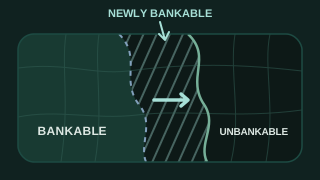
Methane income makes more land financially viable for reforestation.
Methane income raises project returns. In the model, some land then meets the 12% required return.
Impact
Trees remove methane through their bark. This study models how revenue from that uptake could change tropical reforestation finance, project delivery, and forest area.
Mha means million hectares. MtCO₂e/yr means million tonnes of CO₂ equivalent per year. GWP100 compares methane with CO₂ over 100 years. The separate GWP* scenario describes the warming effect of changes in the methane removal rate.
+1.8 Mha
more land meets the 12% required return at $50/tCO₂e under GWP100
+6.1 Mhaunder the separate GWP* scenario
+0.8 Mha
of land is covered by projects expected to secure finance, reach planting, and complete delivery in the central scenario on land already financially viable without methane, under GWP100
+2.8 Mhaunder the separate GWP* scenario
This scenario tests several possible relationships between project returns and delivery. We do not yet have enough project records to measure that relationship directly.
43.4 MtCO₂e/yr
of modeled annual CO₂ and methane uptake once forest growth reaches the full rate, on the study's central creditable basis, for the +2.8 Mha completion scenario
87.0 MtCO₂e/yrof modeled annual CO₂ and methane uptake on the same basis if all 6.1 Mha made newly viable at $50/tCO₂e were built
On that basis, 42.5 MtCO₂/yr comes from tree growth and 0.96 MtCO₂e/yr comes from bark methane. These values include the study's permanence-buffer and leakage deductions. They are not observed or forecast delivery.
No registry credits bark methane today. The bankability result comes from the spatial cash-flow model. The completion result and its annual-capacity case depend on relationships that have not yet been measured across reforestation projects. The market-potential capacity case assumes that all land made financially viable by methane is planted. The results describe possible effects of future methane income.
How the results happen
The study examines five ways methane income could lead to more completed reforestation. They cover financial viability, project delivery, and the timing and amount of financing.
Methane income raises project returns. In the model, some land then meets the 12% required return.
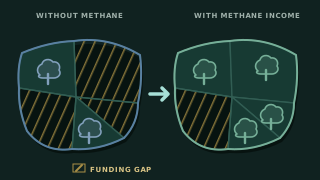
On land already financially viable, added income could help more projects secure finance and reach planting. The study tests possible responses because we do not yet have enough project records to measure the effect.
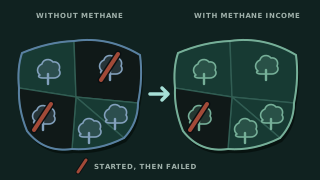
Added income could help a project keep paying for planting, maintenance, and monitoring. The study has no separate estimate for this route.
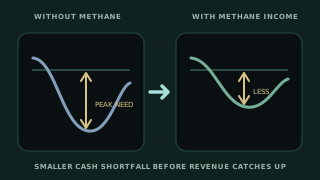
The average peak financing need falls by $18/ha under GWP100 and $61/ha under GWP* in the spatial model.
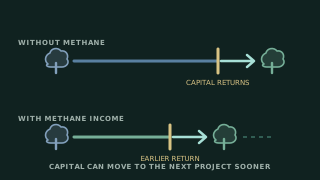
In one 9,000 ha example, cumulative revenue catches up with costs about 1 year sooner under GWP*. The study does not estimate this effect across a portfolio.
The +0.8 Mha and +2.8 Mha completion result covers both more project starts and fewer later failures. The study cannot divide the total between those two routes.
The spatial model uses a 12% required return and a $50/tCO₂e carbon price.
| Effect | GWP100 | GWP* |
|---|---|---|
| Land made financially viable | +1.8 Mha | +6.1 Mha |
| Land covered by projects expected to secure finance, reach planting, and complete delivery, central scenario | +0.8 Mha | +2.8 Mha |
| Projects that avoid failure after work starts | The study has no separate estimate. | The study has no separate estimate. |
| Peak financing need | $18/ha lower (1.6%) | $61/ha lower (5.4%) |
| Break-even in one 9,000 ha example | year 8, unchanged from no methane | year 7, about 1 year sooner |
Financial viability and peak financing need come from the spatial cash-flow model. The completion result shows the central scenario. Across the tested completion scenarios, the increase ranges from 0.64 to 0.84 Mha under GWP100 and 2.43 to 2.85 Mha under GWP*. Project failure has no separate estimate. The break-even result comes from one illustrative project.
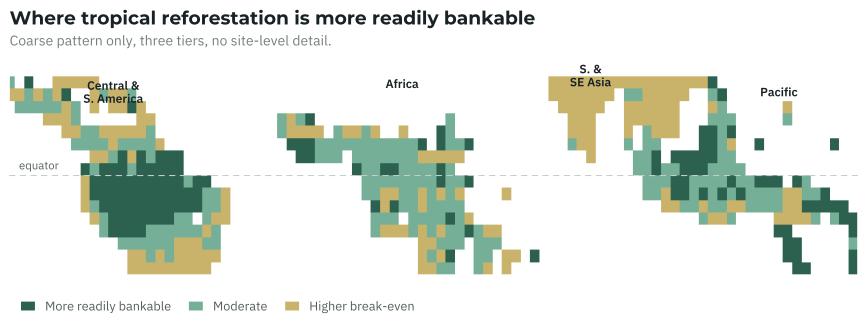
At $50/tCO₂e, the model finds that 62.5 million hectares meet a 12% required return without methane income. Adding methane income makes another 1.8 million hectares financially viable under GWP100, or 6.1 million hectares under the separate GWP* scenario.
These figures identify land where a modeled project meets the 12% return threshold. Actual planting also depends on whether projects secure financing and complete the work. The model applies the mature methane-uptake rate from year one. Measurements from young forests do not yet show how quickly uptake develops.
The spatial cash-flow model covers 5.35 million tropical grid cells.
The completion scenario covers only the 62.5 million hectares already financially viable without methane income. In the central scenario, added income increases the land covered by projects expected to secure finance, reach planting, and complete delivery. The increase is 0.8 million hectares under GWP100 and 2.8 million hectares under GWP*.
The calculation treats the path from finance through planting and delivery as one combined probability. It does not show how much of the increase comes from projects starting or from fewer projects failing later. We do not yet have enough reforestation project data to measure that split.
Across the tested completion scenarios, the increase ranges from 0.64 to 0.84 Mha under GWP100 and 2.43 to 2.85 Mha under GWP*. The scenarios apply only to land already financially viable without methane income.
The scenario starts with 62.5 Mha already financially viable.
Some projects fail after planting begins because they run short of money for later planting, maintenance, or monitoring. Additional methane income could reduce that financial pressure and help some projects continue.
The completion estimate above does not identify how much additional area results from fewer failures. The study does not separately estimate the number of failures prevented or the forest area retained. Such an estimate would require records from many reforestation projects showing when work stopped, why it stopped, and how project finances changed beforehand.
The current study reports no separate project-failure or area estimate.
The study has no separate estimate.
Project records must show why work stopped and what happened to financing before the study can estimate this route.
Reforestation projects spend money before carbon-credit payments arrive. On the 62.5 million hectares already financially viable at $50/tCO₂e, the model estimates an average peak financing need of $1,116/ha without methane income.
Methane income reduces that need by $18/ha, or 1.6%, under GWP100 and by $61/ha, or 5.4%, under GWP*. The calculation assumes payment one year after each year's forest growth and methane uptake. It also assumes mature methane uptake from year one. Advance payments would require a separate calculation.
The model reports the largest cumulative cash shortfall before credit payments catch up with costs.
The average peak financing need starts at $1,116/ha.
In one 9,000 ha project example, cumulative revenue catches up with costs in year 8 without methane and in year 8 under GWP100. It catches up in year 7 under GWP*. Reaching that point sooner could allow a developer to commit funds to another project.
The example uses one cost and payment schedule, a $20/tCO₂e carbon price, no land opportunity cost, and no discounting. The study does not estimate how quickly a developer could reuse that capital across a portfolio or how much additional land the capital could finance.
This result comes from one illustrative project and does not represent the spatial model.
The no-methane and GWP100 cases both reach break-even in year 8. The GWP* case reaches break-even in year 7.
Modeled annual capacity
These are two separate estimates of annual CO₂ and methane uptake once forest growth reaches the full modeled rate. Each reports full-rate capacity on the study's central creditable basis, which applies an 18% permanence buffer and a 10% leakage deduction. They are not observed uptake or forecasts of project delivery. Methane is converted under GWP100.
43.4 MtCO₂e/yrAnnual CO₂ and methane uptake at the full modeled rate, on the study's central creditable basis
This capacity applies to the 2.84 Mha GWP* central completion scenario.
The model uses GWP* values to select the land. It reports the annual result in CO₂-equivalent units, using GWP100 for methane.
87.0 MtCO₂e/yrAnnual CO₂ and methane uptake at the full modeled rate, on the study's central creditable basis
This capacity applies if all 6.1 Mha made financially viable under GWP* at $50/tCO₂e were built.
The model does not predict that all of this land will be financed or planted.
The 43.4 MtCO₂e/yr case covers land already viable without methane. The 87.0 MtCO₂e/yr case covers land made newly viable by methane. Adding them would mix separate cases.
Forest conservation
Credits for protecting carbon stored in existing forests provide most of the modeled project revenue. At $50/tCO₂e, the model estimates that methane income adds about 0.05 Mha of financially viable forest protection under GWP100 and about 0.10 Mha under GWP*. The analysis does not estimate the other project-finance effects for forest conservation.
Methods and sources
The spatial model page explains how the study estimates financial viability across tropical land. The science page covers the field measurements and the methane mechanism.